以前都是用Django自带的用户认证,用户名字段一对一关系对应Django--User表(其实它也是继承了abstractbaseuser)。
from django.contrib.auth.models import User
class UserInfo(models.Model):
username = models.OneToOneField(User)
为什么使用要自定义用户认证?
原生的Django--User认证只有用户名和密码字段,自定义用户认证可以根据项目的需求定制化和扩展认证系统。
比如把唯一标识改成email,或加入用户组等等。
官方说明
官方文档:
Specifying a custom User model(指定自定义用户模型)
使用Django自定义用户模型必须满足:
模型必须有一个唯一的字段,可用于识别目的。
用户给定名称为“短”的标识,用户的全名为“长”标识符。他们可以返回完全相同的值。
构建一个符合用户自定义模型的最简单的方法是继承abstractbaseuser类。abstractbaseuser提供一个用户模型的核心实现,包括密码和符号密码重置。Django自带用用户认证User也是继承了它。一些关键的实现细节:
class models.CustomUser
USERNAME_FIELD
必须有一个唯一标识--USERNAME_FIELD
class MyUser(AbstractBaseUser):
name = models.CharField(max_length=40, unique=True)
...
USERNAME_FIELD = 'name'
REQUIRED_FIELDS
创建superuser时的必须字段
class MyUser(AbstractBaseUser):
...
date_of_birth = models.DateField()
height = models.FloatField()
...
REQUIRED_FIELDS = ['date_of_birth', 'height']
abstractbaseuser提供的方法
is_active(),is_authenticated()......
自定义models(略)
settings中添加models文件名
AUTH_USER_MODEL = 'app.MyUser(类名)'
Django会去models中找这个类,所以要在原生的models.py中导入这个类。
代码实现
asset\user_models.py
#!/usr/bin/env python# -*- coding:utf-8 -*-from django.db import models
from django.contrib.auth.models import (
BaseUserManager, AbstractBaseUser
)class UserProfileManager(BaseUserManager):
def create_user(self, email, name, password=None):
"""
Creates and saves a User with the given email, name and password.
"""
'''email是唯一标识,没有会报错'''
if not email:
raise ValueError('Users must have an email address')
user = self.model(
email=self.normalize_email(email),
name=name,
)
user.set_password(password) #检测密码合理性
user.save(using=self._db) #保存密码
return user
def create_superuser(self, email, name, password):
"""
Creates and saves a superuser with the given email, name and password.
"""
user = self.create_user(email,
password=password,
name=name
)
user.is_admin = True #比创建用户多的一个字段
user.save(using=self._db)
return user
class UserProfile(AbstractBaseUser):
email = models.EmailField(
verbose_name='email address',
max_length=255,
unique=True,
)
name = models.CharField(max_length=32)
is_active = models.BooleanField(default=True)
is_admin = models.BooleanField(default=False)
objects = UserProfileManager() #创建用户
USERNAME_FIELD = 'email'
REQUIRED_FIELDS = ['name']
def get_full_name(self):
# The user is identified by their email address
return self.email
def get_short_name(self):
# The user is identified by their email address
return self.email
def __str__(self): # __unicode__ on Python 2
return self.email
'''django自带后台权限控制,对哪些表有查看权限等'''
def has_perm(self, perm, obj=None):
"Does the user have a specific permission?"
# Simplest possible answer: Yes, always
return True
'''用户是否有权限看到app'''
def has_module_perms(self, app_label):
"Does the user have permissions to view the app `app_label`?"
# Simplest possible answer: Yes, always
return True
@property
def is_staff(self):
"Is the user a member of staff?"
# Simplest possible answer: All admins are staff
return self.is_admin
asset\models.py
from asset.user_models import UserProfile
myCMDB\settings.py
AUTH_USER_MODEL = 'asset.UserProfile'
asset\admin.py
from asset import models
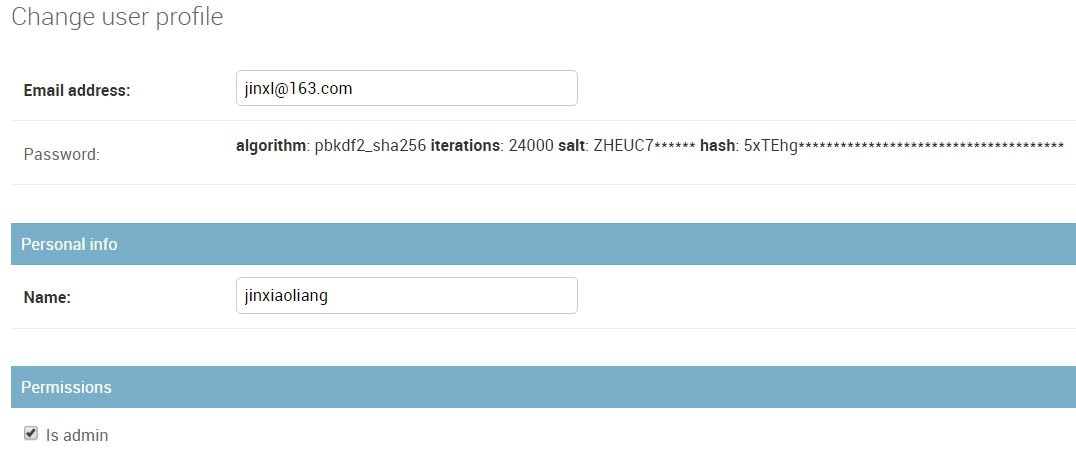
admin.site.register(models.UserProfile)初始化数据库,登录后台。此时密码是明文显示,如果想改密码怎么办?
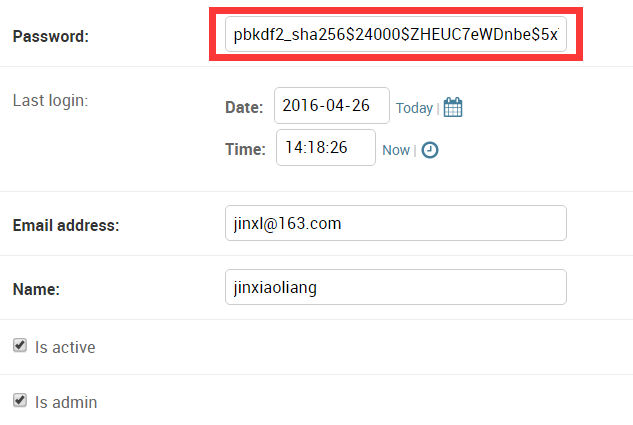
这时,需要自定义admin显示(官方都提供了)。
asset\admin.py
from user_admin import UserAdmin
admin.site.register(models.UserProfile,UserAdmin)asset\user_admin.py
#!/usr/bin/env python# -*- coding:utf-8 -*-from django import forms
from django.contrib import admin
from django.contrib.auth.models import Group
from django.contrib.auth.admin import UserAdmin as BaseUserAdmin
from django.contrib.auth.forms import ReadOnlyPasswordHashField
from asset.models import UserProfile
class UserCreationForm(forms.ModelForm):
"""A form for creating new users. Includes all the required
fields, plus a repeated password."""
password1 = forms.CharField(label='Password', widget=forms.PasswordInput)
password2 = forms.CharField(label='Password confirmation', widget=forms.PasswordInput)
class Meta:
model = UserProfile
fields = ('email', 'name')
def clean_password2(self):
# Check that the two password entries match
password1 = self.cleaned_data.get("password1")
password2 = self.cleaned_data.get("password2")
if password1 and password2 and password1 != password2:
raise forms.ValidationError("Passwords don't match")
return password2
def save(self, commit=True):
# Save the provided password in hashed format
user = super(UserCreationForm, self).save(commit=False)
user.set_password(self.cleaned_data["password1"])
if commit:
user.save()
return user
class UserChangeForm(forms.ModelForm):
"""A form for updating users. Includes all the fields on
the user, but replaces the password field with admin's
password hash display field.
"""
password = ReadOnlyPasswordHashField()
class Meta:
model = UserProfile
fields = ('email', 'password', 'name', 'is_active', 'is_admin')
def clean_password(self):
# Regardless of what the user provides, return the initial value.
# This is done here, rather than on the field, because the
# field does not have access to the initial value
return self.initial["password"]
class UserAdmin(BaseUserAdmin):
# 以前是ModelAdmin
# The forms to add and change user instances
form = UserChangeForm
add_form = UserCreationForm
# The fields to be used in displaying the User model.
# These override the definitions on the base UserAdmin
# that reference specific fields on auth.User.
list_display = ('email', 'name', 'is_admin') #这个和以前一样,显示什么
list_filter = ('is_admin',)
fieldsets = (
(None, {'fields': ('email', 'password')}),
('Personal info', {'fields': ('name',)}),
('Permissions', {'fields': ('is_admin',)}),
)
# add_fieldsets is not a standard ModelAdmin attribute. UserAdmin
# overrides get_fieldsets to use this attribute when creating a user.
add_fieldsets = (
(None, {
'classes': ('wide',),
'fields': ('email', 'name', 'password1', 'password2')}
),
)
search_fields = ('email',)
ordering = ('email',)
filter_horizontal = ()
# Now register the new UserAdmin...#admin.site.register(UserProfile, UserAdmin)# ... and, since we're not using Django's built-in permissions,# unregister the Group model from admin.admin.site.unregister(Group) #不显示系统自带的group
后台效果