Problem
Two events independent if Pr(A)×Pr(B). In other words, the events do not influence each other, so that we may simply calculate each of the individual probabilities separately and then multiply.
More generally, random variables independent if whenever Pr(A and B)=Pr(A)×Pr(B)).
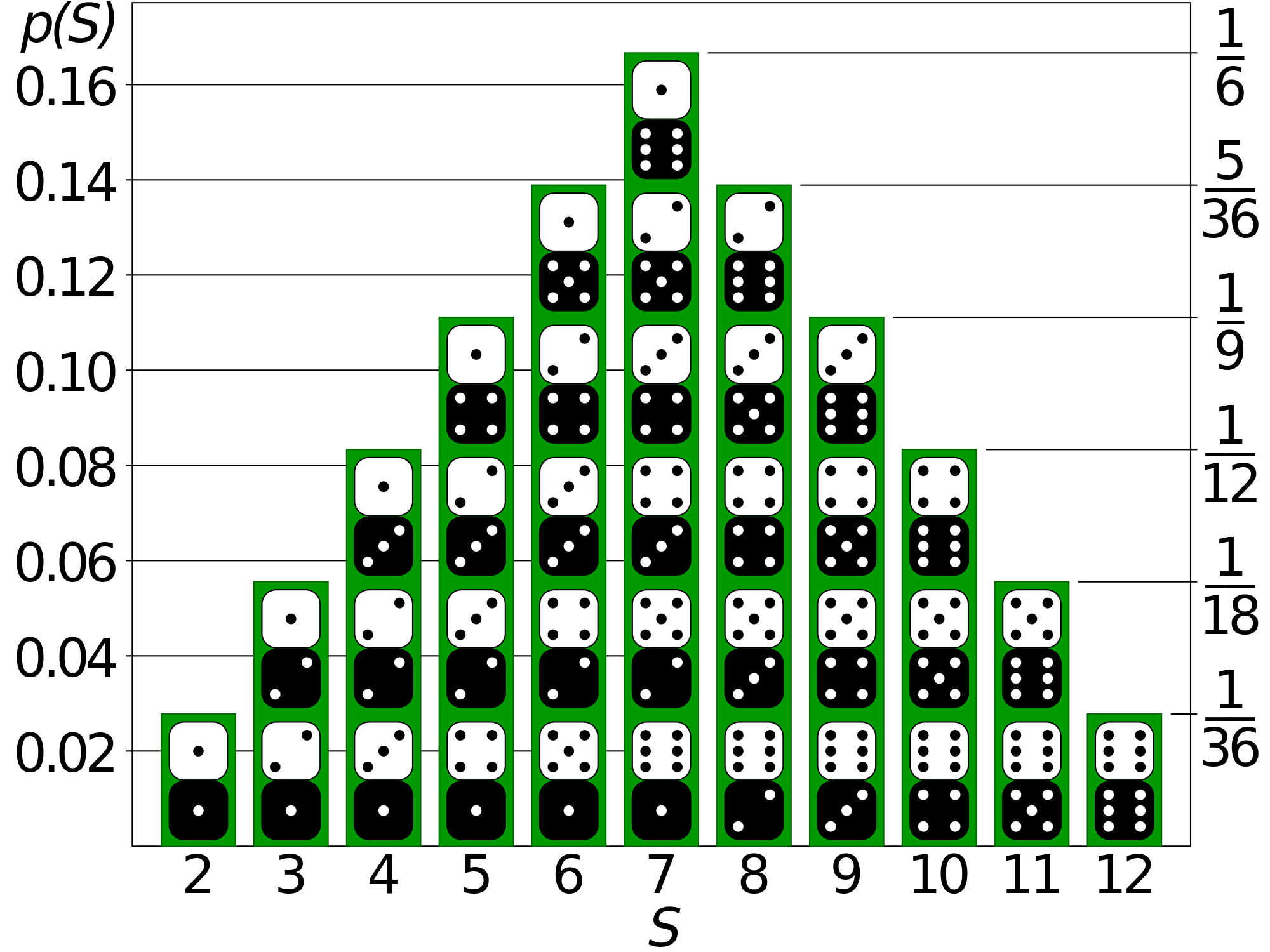
As an example of how helpful independence can be for calculating probabilities, let Figure 2, which shows all 36 outcomes for rolling two dice.
Given: Two positive integers N≤2k). In this problem, we begin with Tom, who in the 0th generation has genotype Aa Bb. Tom has two children in the 1st generation, each of whom has two children, and so on. Each organism always mates with an organism having genotype Aa Bb.
Return: The probability that at least k-th generation of Tom's family tree (don't count the Aa Bb mates at each level). Assume that Mendel's second law holds for the factors.
Sample Dataset
2 1
Sample Output
0.684


方法一:
import itertools
def f(k,n):
    p = []
    child_num = 2**k
    for i in range(n):
        p.append(len(list(itertools.combinations([x for x in range(child_num)],i)))*(0.25**i)*(0.75**(child_num-i)))
        # combinations('ABCD', 2)		AB AC AD BC BD CD
    return 1-sum(p)

print f(5,8)