Cross validation is an essential tool in statistical learning 1 to estimate the accuracy of your algorithm. Despite its great power it also exposes some fundamental risk when done wrong which may terribly bias your accuracy estimate.
In this blog post I'll demonstrate - using the Python scikit-learn2framework - how to avoid the biggest and most common pitfall of cross validation in your experiments.
Theory first
Cross validation involves randomly dividing the set of observations intok groups (or folds) of approximately equal size. The first fold is treated as a validation set, and the machine learning algorithm is trained on the remaining k-1 folds. The mean squared error is then computed on the held-out fold. This procedure is repeated k times; each time, a different group of observations is treated as a validation set.
This process results in k estimates of the MSE quantity, namely k. The cross validation estimate for the MSE is then computed by simply averaging these values:
This value is an estimate, say E and our goal is to make this estimate as accurate as possible.
Hands on
Let's now have a look at one of the most typical mistakes when using cross validation. When cross validation is done wrong the result is that E, while in reality you simply wrongly applied CV.
I'll first show you - hands on - a wrong application of cross validation and then we will fix it together. The code is also available as an IPython notebook on github.
Dataset generation
|
1
2
3
4
5
6
7
8
9
|
# Import pandas
pd
import *
# Import scikit-learn
LogisticRegression
import *
import *
random
|
To make things simple let's first generate some random data and let's pretend that we want to build a machine learning algorithm to predict the outcome. I'll first generate a dataset of 100 entries. Each entry has10.000 features. But, why so many? Well, to demonstrate our issue I need to generate some correlation between our inputs and output which is purely casual. You'll understand the why later in this post.
|
1
2
3
4
5
6
|
)
)
)
target
)
|
Feature selection
At this point we would like to know what are the features that are more useful to train our predictor. This is called feature selection. The simplest approach to do that is to find which of the 10.000 features in our input is mostly correlated the target. Using pandas this is very easy to do thanks to the corr() function. We run corr() on our dataframe, we order the correlation values, and we pick the first two features.
|
1
2
3
4
5
6
7
8
9
10
|
)
)
)
# 3122 0.392430
# 830 0.367405
# 8374 0.351462
# 9801 0.341806
# 5585 0.336950
# Name: target, dtype: float64
|
Start the training
Great! Out of the 10.000 features we have been able to select two of them, i.e. feature number 3122 and 830 that have a 0.36 and 0.39correlation with the output. At this point let's just drop all the other columns and use these two features to train a simpleLogisticRegression. We then use scikit-learn cross_val_score to compute ^ which in this case is equal to 0.33. Pretty good!
|
1
2
3
4
5
6
7
8
9
10
11
12
13
14
15
16
|
values
values
]
)
# scikit learn return the negative value for MSE
# http://stackoverflow.com/questions/21443865/scikit-learn-cross-validation-negative-values-with-mean-squared-error
)
mse_estimate
# array([ 0.45454545, 0.27272727, 0.27272727, 0.5 , 0.4 ,
# 0.2 , 0.2 , 0.44444444, 0.33333333, 0.22222222])
)
# 0 0.33
# dtype: float64
|
Knowledge leaking
According to the previous estimate we built a system that can predict a random noise target from a random noise input with a E of just0.33. The result is, as you can expect, wrong. But why?
The reason is rather counterintuitive and this is why this mistake is so commoni in the i-th iteration of the cross validation you should be using only the information on the training fold, and nothing should come from the test fold. In our case the model did indeed have information from the test fold, i.e. the top correlated features. I think the term knowledge leaking express this concept fairly well.
The schema that follows shows you how the knowledge leaked into theLogisticRegression because the feature selection has been appliedbefore the cross validation procedure started. The model knows something about the data highlighted in yellow that it shoulnd't know, its top correlated features.
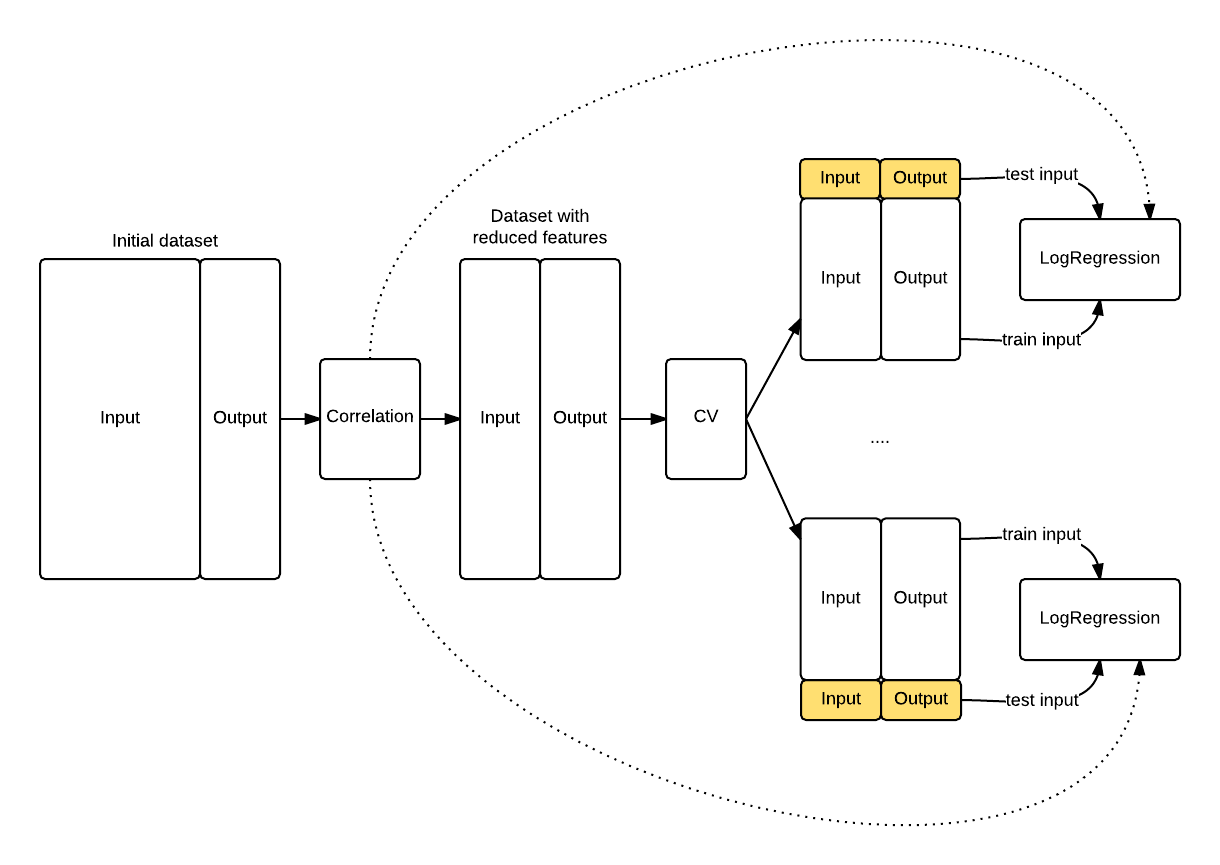 Figure 1. The exposed knowledge leaking. The LogisticRegression knows the top correlated features of the entire dataset (hence including test folds) because of the initial correlation operation, whilst it should be exposed only to the training fold information.
Proof that our model is biased
To check that we were actually wrong let's do the following:
* Take out a portion of the data set (take_out_set).
* Train the LogisticRegression on the remaining data using the same feature selection we did before.
* After the training is done check the E on the take_out_set.
Is the ^ of 0.33.
|
1
2
3
4
5
6
7
8
9
10
11
12
13
14
15
16
17
18
19
20
21
|
]
]
)
)
values
values
]
)
)
# LogisticRegression(C=1.0, class_weight=None, dual=False, fit_intercept=True,
# intercept_scaling=1, max_iter=100, multi_class='ovr',
# penalty='l2', random_state=None, solver='liblinear', tol=0.0001,
# verbose=0)
)
)
# 0.53333333333333333
|
Cross validation done right
In the previous section we have seen that if you inject test knowledge in your model your cross validation procedure will be biased. To avoid this let's compute the features correlation during each cross validation batch. The difference is that now the features correlation will use only the information in the training fold instead of the entire dataset. That's the key insight causing the bias we saw previously. The following graph shows you the revisited procedure. This time we got a realistic ^ of0.53 that confirms the data is randomly distributed.
 Figure 2. Revisited cross validation workflow with the correlation step performed for each of the K train/test folds.
|
1
2
3
4
5
6
7
8
9
10
11
12
13
14
15
16
17
18
19
20
21
22
23
24
25
26
27
28
29
30
31
32
33
34
35
36
37
38
39
40
41
42
43
44
|
)
]
0
:
)
]
]
# find best features
)
)
values
# Get training examples
values
]
# Fit logistic regression
)
)
# Check MSE on test set
)
)
# Done with the fold
1
)
# Processing fold 0
# Processing fold 1
# Processing fold 2
# Processing fold 3
# Processing fold 4
# Processing fold 5
# Processing fold 6
# Processing fold 7
# Processing fold 8
# Processing fold 9
)
# 0 0.53
# dtype: float64
|
Conclusion
We have seen how doing features selection at the wrong step can terribly bias the E estimate of your machine learning algorithm. We have also seen how to correctly apply cross validation by simply moving one step down the features selection such that the knowledge from the test data does not leak in our learning procedure.
If you want to make sure you don't leak info across the train and test set scikit learn gives you additional extra tools like the feature selection pipeline5.
Finally, if you want know more about cross validation and its tradeoffs both R. Kohavi7 wrote on this topic.
If you liked this post you should consider following me on twitter.
Let me know your comments!
References
- Lecture 1 on cross validation - Statistical Learning @ Stanford
- Scikit-learn framework
- Lecture 2 on cross validation - Statistical Learning @ Stanford
- Scikit-learn feature selection pipeline
- Scikit-learn feature selection modules
- R. Kohavi. A study of cross-validation and bootstrap for accuracy estimation and model selection
- Y. Bengio and Y. Grandvalet. No unbiased estimator of the variance of k-fold cross-validation
Posted onJuly 29, 2015
To do feature selection inside a cross-validation loop, you should really be using the feature selection objects inside a pipeline:
http://scikit-learn.org/stable/auto_examples/feature_selection/feature_selection_pipeline.html
http://scikit-learn.org/stable/modules/feature_selection.html
That way you can use the model selection tools of scikit-learn:
http://scikit-learn.org/stable/modules/model_evaluation.html
And you are certain that you won't be leaking info across train and test sets.