转自:http://my.oschina.net/yangyanxing/blog/280029
早就听说requests的库的强大,只是还没有接触,今天接触了一下,发现以前使用urllib,urllib2等方法真是太搓了……
这里写些简单的使用初步作为一个记录
一、安装 http://cn.python-requests.org/en/latest/user/install.html#install
二、发送无参数的get请求
|
1
2
3
4
5
6
7
8
9
10
11
12
13
14
15
|
>>> print r.text
{ "args": {},
"headers": {
"Accept": "*/*",
"Accept-Encoding": "gzip, deflate",
"Connection": "close",
"Host": "httpbin.org",
"User-Agent": "python-requests/2.3.0 CPython/2.6.6 Windows/7",
"X-Request-Id": "8a28bbea-55cd-460b-bda3-f3427d66b700"
},
"origin": "124.192.129.84",
} |
三、发送带参数的get请求,将key与value放入一个字典中,通过params参数来传递,其作用相当于urllib.urlencode
|
1
2
3
4
5
|
>>> import requests
>>> pqyload = {'q':'杨彦星'}
>>> r.url |
四、发送post请求,通过data参数来传递,
|
1
2
3
4
5
6
7
8
9
10
11
12
13
14
15
16
17
18
19
20
21
22
23
24
25
26
|
>>> payload = {'a':'杨','b':'hello'}
>>> print r.text
{ "args": {},
"data": "",
"files": {},
"form": {
"a": "\u6768",
"b": "hello"
},
"headers": {
"Accept": "*/*",
"Accept-Encoding": "gzip, deflate",
"Connection": "close",
"Content-Length": "19",
"Content-Type": "application/x-www-form-urlencoded",
"Host": "httpbin.org",
"User-Agent": "python-requests/2.3.0 CPython/2.6.6 Windows/7",
"X-Request-Id": "c81cb937-04b8-4a2d-ba32-04b5c0b3ba98"
},
"json": null,
"origin": "124.192.129.84",
}>>> |
可以看到,post参数已经传到了form里,data不光可以接受字典类型的数据,还可以接受json等格式
|
1
2
3
|
>>> payload = {'a':'杨','b':'hello'}
>>> import json
|
五、发送文件的post类型,这个相当于向网站上传一张图片,文档等操作,这时要使用files参数
|
1
2
3
|
>>> files = {'file': open('touxiang.png', 'rb')}
>>> r = requests.post(url, files=files)
|
5.1 定制headers,使用headers参数来传递
|
1
2
3
4
5
6
|
>>> import json
>>> payload = {'some': 'data'}
>>> headers = {'content-type': 'application/json'}
>>> r = requests.post(url, data=json.dumps(payload), headers=headers)
|
六、响应内容
6.1 响应状态码
r = requests.get('http://httpbin.org/get')
print r.status_code
6.2 响应头
|
1
2
|
>>> print r.headers
{'content-length': '519', 'server': 'gunicorn/18.0', 'connection': 'keep-alive', 'date': 'Sun, 15 Jun 2014 14:19:52 GMT', 'access-control-allow-origin': '*', 'content-type': 'application/json'}
|
也可以取到这个个别的响应头用来做一些判断,这里的参数是不区分大小写的
r.headers[‘Content-Type’]
r.headers.get(‘Content-Type’)
6.3 响应内容,前面已经在应用了
r.text
r.content
七、获取响应中的cookies
|
1
2
3
|
>>> r.cookies['BAIDUID']
'D5810267346AEFB0F25CB0D6D0E043E6:FG=1' |
也可以自已定义请求的COOKIES
|
1
2
3
4
5
6
7
8
9
10
11
|
>>> cookies = {'cookies_are':'working'}
>>> r = requests.get(url,cookies = cookies)
>>> >>> print r.text
{ "cookies": {
"cookies_are": "working"
}
}>>> |
cookies还有很多,因为目前我也还不是很多,以后再扩充吧
八、使用timeout参数设置超时时间
>>> requests.get('http://github.com', timeout=1)
<Response [200]>
如果将时间设置成非常小的数,如requests.get('http://github.com', timeout=0.001),那么如果在timeout的时间内没有连接,那么将会抛出一个Timeout的异常
九、访问中使用session
先初始化一个session对象,s = requests.Session()
然后使用这个session对象来进行访问,r = s.post(url,data = user)
参考文章 http://blog.csdn.net/iloveyin/article/details/21444613 基本上都是从这扒的代码
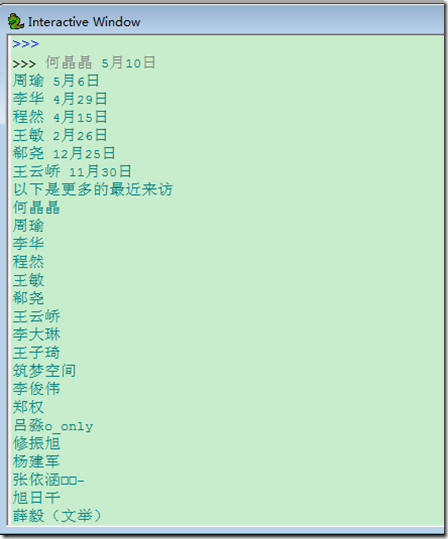
以下通过访问人人网来获取首页中的最近来访问,然后再访问查看更多的来访来读取更多的最近来访
更多的来访就是以带session的访问http://www.renren.com/myfoot.do
|
1
2
3
4
5
6
7
8
9
10
11
12
13
14
15
16
17
18
19
20
21
22
23
24
25
26
27
28
29
|
#coding:utf-8import requests
import re
user = {'email':'email','password':'pass'}
s = requests.Session()
r = s.post(url,data = user)
html = r.text
visit = []
first = re.compile(r'</span><span class="time-tip first-tip"><span class="tip-content">(.*?)</span>')
second = re.compile(r'</span><span class="time-tip"><span class="tip-content">(.*?)</span>')
third = re.compile(r'</span><span class="time-tip last-second-tip"><span class="tip-content">(.*?)</span>')
last = re.compile(r'</span><span class="time-tip last-tip"><span class="tip-content">(.*?)</span>')
visit.extend(first.findall(html))visit.extend(second.findall(html))visit.extend(third.findall(html))visit.extend(last.findall(html))for i in visit:
print i
print '以下是更多的最近来访'
fm = re.compile(r'"name":"(.*?)"')
visitmore = fm.findall(vm.text)
for i in visitmore:
print i
|