概要
前面,我们已经学习了ArrayList,并了解了fail-fast机制。这一章我们接着学习List的实现类——LinkedList。
和学习ArrayList一样,接下来呢,我们先对LinkedList有个整体认识,然后再学习它的源码;最后再通过实例来学会使用LinkedList。内容包括:
第1部分 LinkedList介绍
第2部分 LinkedList数据结构
第3部分 LinkedList源码解析(基于JDK1.8)
第4部分 LinkedList遍历方式
第5部分 LinkedList示例
第1部分 LinkedList介绍
LinkedList简介
LinkedList 是一个继承于AbstractSequentialList的双向链表,不是循环的(头尾不相连)。它也可以被当作堆栈、队列或双端队列进行操作。
LinkedList 实现 List 接口,能对它进行队列操作。
LinkedList 实现 Deque 接口,即能将LinkedList当作双端队列使用。
LinkedList 实现了Cloneable接口,即覆盖了函数clone(),能克隆。
LinkedList 实现java.io.Serializable接口,这意味着LinkedList支持序列化,能通过序列化去传输。
LinkedList 是非同步的。
LinkedList构造函数
// 默认构造函数
LinkedList()

// 创建一个LinkedList,保护Collection中的全部元素。
LinkedList(Collection<? extends E> collection)
LinkedList的API
LinkedList的API
boolean       add(E object)
void          add(int location, E object)
boolean       addAll(Collection<? extends E> collection)
boolean       addAll(int location, Collection<? extends E> collection)
void          addFirst(E object)
void          addLast(E object)
void          clear()
Object        clone()
boolean       contains(Object object)
Iterator<E>   descendingIterator()
E             element()
E             get(int location)
E             getFirst()
E             getLast()
int           indexOf(Object object)
int           lastIndexOf(Object object)
ListIterator<E>     listIterator(int location)
boolean       offer(E o)
boolean       offerFirst(E e)
boolean       offerLast(E e)
E             peek()
E             peekFirst()
E             peekLast()
E             poll()
E             pollFirst()
E             pollLast()
E             pop()
void          push(E e)
E             remove()
E             remove(int location)
boolean       remove(Object object)
E             removeFirst()
boolean       removeFirstOccurrence(Object o)
E             removeLast()
boolean       removeLastOccurrence(Object o)
E             set(int location, E object)
int           size()
<T> T[]       toArray(T[] contents)
Object[]     toArray()
AbstractSequentialList简介
在介绍LinkedList的源码之前,先介绍一下AbstractSequentialList。毕竟,LinkedList是AbstractSequentialList的子类。
AbstractSequentialList 实现了get(int index)、set(int index, E element)、add(int index, E element) 和 remove(int index)这些函数。这些接口都是随机访问List的,LinkedList是双向链表;既然它继承于AbstractSequentialList,就相当于已经实现了“get(int index)这些接口”。
此外,我们若需要通过AbstractSequentialList自己实现一个列表,只需要扩展此类,并提供 listIterator() 和 size() 方法的实现即可。若要实现不可修改的列表,则需要实现列表迭代器的 hasNext、next、hasPrevious、previous 和 index 方法即可。
第2部分 LinkedList数据结构
LinkedList的继承关系
java.lang.Object
   ↳     java.util.AbstractCollection<E>
         ↳     java.util.AbstractList<E>
               ↳     java.util.AbstractSequentialList<E>
                     ↳     java.util.LinkedList<E>

public class LinkedList<E>
    extends AbstractSequentialList<E>
    implements List<E>, Deque<E>, Cloneable, java.io.Serializable {}
LinkedList与Collection关系如下图:
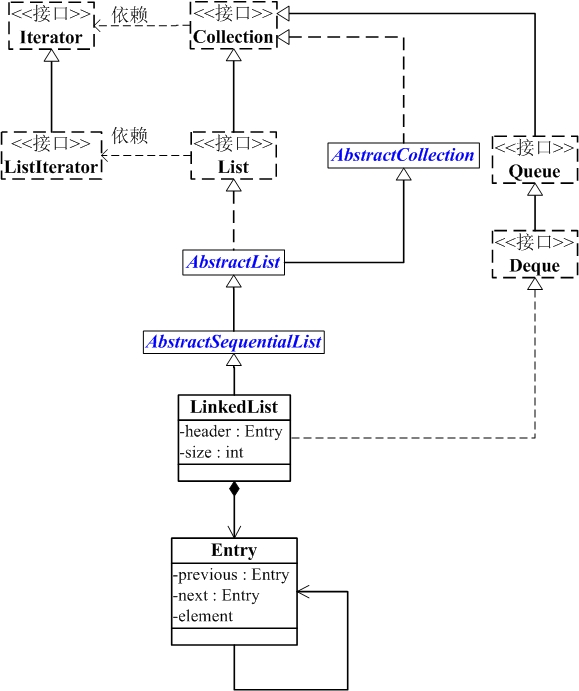
LinkedList的本质是不循环的双向链表。
(01) LinkedList继承于AbstractSequentialList,并且实现了Dequeue接口。
(02) LinkedList包含两个重要的成员:header 和 size。
header是双向链表的表头,它是双向链表节点所对应的类Entry的实例。Entry中包含成员变量: previous, next, element。其中,previous是该节点的上一个节点,next是该节点的下一个节点,element是该节点所包含的值。
size是双向链表中节点的个数。
第3部分 LinkedList源码解析(基于JDK1.8)
为了更了解LinkedList的原理,下面对LinkedList源码代码作出分析。
在阅读源码之前,我们先对LinkedList的整体实现进行大致说明:
LinkedList实际上是通过双向链表去实现的。既然是双向链表,那么它的顺序访问会非常高效,而随机访问效率比较低。
既然LinkedList是通过双向链表的,但是它也实现了List接口{也就是说,它实现了get(int location)、remove(int location)等“根据索引值来获取、删除节点的函数”}。LinkedList是如何实现List的这些接口的,如何将“双向链表和索引值联系起来的”?
实际原理非常简单,它就是通过一个计数索引值来实现的。例如,当我们调用get(int location)时,首先会比较“location”和“双向链表长度的1/2”;若前者大,则从链表头开始往后查找,直到location位置;否则,从链表末尾开始先前查找,直到location位置。
这就是“双线链表和索引值联系起来”的方法。
好了,接下来开始阅读源码(只要理解双向链表,那么LinkedList的源码很容易理解的)。
package java.util;

import java.util.function.Consumer;


public class LinkedList<E>
        extends AbstractSequentialList<E>
        implements List<E>, Deque<E>, Cloneable, java.io.Serializable
{
    transient int size = 0;

    /**
     * 指向第一个节点
     */
    transient Node<E> first;

    /**
     * 指向最后一个节点
     */
    transient Node<E> last;

    /**
     * 默认构造空链表
     */
    public LinkedList() {
    }


    public LinkedList(Collection<? extends E> c) {
        this();
        addAll(c);
    }

    /**
     * 插入元素,作为第一个节点(链表头部插入节点)
     * 先将头结点取出,并构建新节点赋给first
     */
    private void linkFirst(E e) {
        final Node<E> f = first;
        /**
         * 构造第一个节点,它上一个节点是null,下一个节点是first。并将此节点赋给first
         */
        final Node<E> newNode = new Node<>(null, e, f);
        first = newNode;
        /**
         * 如果一开始首节点是空,那么也就是链表为空,此时last节点也是该新节点
         * 如果一开始首节点非空,将新节点插入到f节点前面
         */
        if (f == null)
            last = newNode;
        else
            f.prev = newNode;
        size++;
        modCount++;
    }

    /**
     * 插入链表最后。同上
     */
    void linkLast(E e) {
        final Node<E> l = last;
        final Node<E> newNode = new Node<>(l, e, null);
        last = newNode;
        if (l == null)
            first = newNode;
        else
            l.next = newNode;
        size++;
        modCount++;
    }

    /**
     * 在succ节点之前插入节点。
     * 1.取出succ节点前面的节点
     * 2.创建新节点,指向前面节点和succ节点
     * 3.插入(前面节点的next为新节点,succ节点的pre节点为新节点)
     */
    void linkBefore(E e, Node<E> succ) {
        // assert succ != null;
        final Node<E> pred = succ.prev;//1
        final Node<E> newNode = new Node<>(pred, e, succ);//2
        succ.prev = newNode;
        if (pred == null)  //前面节点为空(succ节点为first节点)
            first = newNode;
        else
            pred.next = newNode;
        size++;
        modCount++;
    }

    /**
     * 将第一个节点first从链表中删除。
     * 1.取出first的next节点,并将first设为null。
     * 2.将first删除(first=next)
     * 3.考虑特殊情况,只有一个节点(next==null),删掉后last=null
     */
    private E unlinkFirst(Node<E> f) {
        // assert f == first && f != null;
        final E element = f.item;
        final Node<E> next = f.next;
        f.item = null;
        f.next = null; // help GC
        first = next;
        if (next == null)
            last = null;
        else
            next.prev = null;
        size--;
        modCount++;
        return element;
    }

    /**
     * 同上
     */
    private E unlinkLast(Node<E> l) {
        // assert l == last && l != null;
        final E element = l.item;
        final Node<E> prev = l.prev;
        l.item = null;
        l.prev = null; // help GC
        last = prev;
        if (prev == null)
            first = null;
        else
            prev.next = null;
        size--;
        modCount++;
        return element;
    }

    /**
     * Unlinks non-null node x.
     */
    E unlink(Node<E> x) {
        // assert x != null;
        final E element = x.item;
        final Node<E> next = x.next;
        final Node<E> prev = x.prev;

        if (prev == null) {
            first = next;
        } else {
            prev.next = next;
            x.prev = null;
        }

        if (next == null) {
            last = prev;
        } else {
            next.prev = prev;
            x.next = null;
        }

        x.item = null;
        size--;
        modCount++;
        return element;
    }

    /**
     * 返回第一个节点的元素
     */
    public E getFirst() {
        final Node<E> f = first;
        if (f == null)
            throw new NoSuchElementException();
        return f.item;
    }

    /**
     * 返回最后一个节点
     */
    public E getLast() {
        final Node<E> l = last;
        if (l == null)
            throw new NoSuchElementException();
        return l.item;
    }

    /**
     * 删除第一个节点
     */
    public E removeFirst() {
        final Node<E> f = first;
        if (f == null)
            throw new NoSuchElementException();
        return unlinkFirst(f);
    }


    public E removeLast() {
        final Node<E> l = last;
        if (l == null)
            throw new NoSuchElementException();
        return unlinkLast(l);
    }

    /**
     * 头部添加节点
     */
    public void addFirst(E e) {
        linkFirst(e);
    }

    /**
     * 尾部添加
     */
    public void addLast(E e) {
        linkLast(e);
    }


    public boolean contains(Object o) {
        return indexOf(o) != -1;
    }


    public int size() {
        return size;
    }

    /**
     * add是从尾部添加
     */
    public boolean add(E e) {
        linkLast(e);
        return true;
    }

    /**
     * 删除元素:考虑空和非空。LinkedList也可以存null
     */
    public boolean remove(Object o) {
        if (o == null) {
            for (Node<E> x = first; x != null; x = x.next) {
                if (x.item == null) {
                    unlink(x);
                    return true;
                }
            }
        } else {
            for (Node<E> x = first; x != null; x = x.next) {
                if (o.equals(x.item)) {
                    unlink(x);
                    return true;
                }
            }
        }
        return false;
    }


    public boolean addAll(Collection<? extends E> c) {
        return addAll(size, c);
    }


    public void clear() {
        // Clearing all of the links between nodes is "unnecessary", but:
        // - helps a generational GC if the discarded nodes inhabit
        //   more than one generation
        // - is sure to free memory even if there is a reachable Iterator
        for (Node<E> x = first; x != null; ) {
            Node<E> next = x.next;
            x.item = null;
            x.next = null;
            x.prev = null;
            x = next;
        }
        first = last = null;
        size = 0;
        modCount++;
    }


    // Positional Access Operations

    /**
     * 获得指定下标的元素,会遍历,O(n)
     */
    public E get(int index) {
        checkElementIndex(index);
        return node(index).item;
    }


    public E set(int index, E element) {
        checkElementIndex(index);
        Node<E> x = node(index);
        E oldVal = x.item;
        x.item = element;
        return oldVal;
    }

    /**
     * 在index位置加入元素。
     * 先找到该位置的节点,将新元素插入到该节点前面
     */
    public void add(int index, E element) {
        checkPositionIndex(index);

        if (index == size)
            linkLast(element);
        else
            linkBefore(element, node(index));
    }


    public E remove(int index) {
        checkElementIndex(index);
        return unlink(node(index));
    }


    /**
     * 返回指定下标的节点。会遍历
     * 这里index在前半部分还是后半部分,在前半部分则从头开始遍历,后半部分则从尾部开始遍历
     */
    Node<E> node(int index) {
        // assert isElementIndex(index);

        if (index < (size >> 1)) {
            Node<E> x = first;
            for (int i = 0; i < index; i++)
                x = x.next;
            return x;
        } else {
            Node<E> x = last;
            for (int i = size - 1; i > index; i--)
                x = x.prev;
            return x;
        }
    }

    // Search Operations

    /**
     * 找到对应元素的下标。从头开始遍历。O(n)
     */
    public int indexOf(Object o) {
        int index = 0;
        if (o == null) {
            for (Node<E> x = first; x != null; x = x.next) {
                if (x.item == null)
                    return index;
                index++;
            }
        } else {
            for (Node<E> x = first; x != null; x = x.next) {
                if (o.equals(x.item))
                    return index;
                index++;
            }
        }
        return -1;
    }

    /**
     * 从后开始找
     */
    public int lastIndexOf(Object o) {
        int index = size;
        if (o == null) {
            for (Node<E> x = last; x != null; x = x.prev) {
                index--;
                if (x.item == null)
                    return index;
            }
        } else {
            for (Node<E> x = last; x != null; x = x.prev) {
                index--;
                if (o.equals(x.item))
                    return index;
            }
        }
        return -1;
    }

    // Queue operations.

    /**
     * 弹出第一个元素,并不删除
     */
    public E peek() {
        final Node<E> f = first;
        return (f == null) ? null : f.item;
    }


    public E element() {
        return getFirst();
    }

    /**
     * 弹出第一个元素并删除
     */
    public E poll() {
        final Node<E> f = first;
        return (f == null) ? null : unlinkFirst(f);
    }


    public E remove() {
        return removeFirst();
    }

    /**
     * 默认从尾部添加
     */
    public boolean offer(E e) {
        return add(e);
    }

    // Deque operations

    public boolean offerFirst(E e) {
        addFirst(e);
        return true;
    }


    public boolean offerLast(E e) {
        addLast(e);
        return true;
    }

    /**
     * 弹出第一个元素,但不删除
     */
    public E peekFirst() {
        final Node<E> f = first;
        return (f == null) ? null : f.item;
    }


    public E peekLast() {
        final Node<E> l = last;
        return (l == null) ? null : l.item;
    }

    /**
     * 弹出第一个元素,而且删除
     */
    public E pollFirst() {
        final Node<E> f = first;
        return (f == null) ? null : unlinkFirst(f);
    }


    public E pollLast() {
        final Node<E> l = last;
        return (l == null) ? null : unlinkLast(l);
    }

    /**
     * 从头加
     */
    public void push(E e) {
        addFirst(e);
    }

    /**
     * 删除第一个元素
     */
    public E pop() {
        return removeFirst();
    }

    /**
     * 双向链表。头结点的pref是Null.尾节点的next是null
     * @param <E>
     */
    private static class Node<E> {
        E item;
        Node<E> next;
        Node<E> prev;

        Node(Node<E> prev, E element, Node<E> next) {
            this.item = element;
            this.next = next;
            this.prev = prev;
        }
    }

}